Affirmations are among the most popular practices in the manifestation community. Open almost any manifestation book, watch almost any YouTube video, or join almost any discussion about conscious creation and you will eventually encounter affirmations.
People are encouraged to repeat statements such as: I am wealthy. I am successful. I am loved. Everything always works out for me.
For some individuals affirmations appear to produce meaningful changes. For others they seem ineffective, frustrating, or even dishonest.
This raises an important question: If affirmations are so powerful, why do so many people struggle with them?
The answer often lies in a misunderstanding of what affirmations are meant to accomplish. Many people assume affirmations create reality through repetition alone. Neville Goddard's teachings point to something deeper. The issue is not repetition. The issue is state.
Why So Many People Become Frustrated With Affirmations
Most people begin using affirmations with enthusiasm. Eventually many encounter a problem. Their outer circumstances remain unchanged.
The affirmation says, "I am confident," yet insecurity continues to appear. The affirmation says, "I am abundant," yet financial stress remains. The affirmation says, "I am loved," yet relationship difficulties persist.
The problem is not necessarily the affirmation itself. The problem is that the individual remains identified with the same state that produced the unwanted experience.
What Neville Goddard Actually Taught
One of the most common misunderstandings about Neville Goddard's work is the belief that he taught techniques. While Neville discussed techniques, his focus was never the technique itself. His focus was consciousness.
Neville repeatedly taught that consciousness is the only reality. He did not teach that affirmations create experience. He taught that consciousness creates experience.
Techniques are tools. States are causes.
Affirmations Are Not Magic Words
Many manifestation teachings unintentionally treat affirmations as though they possess magical properties. Words alone do not create transformation.
Consider two people repeating the same affirmation. One remains identified with failure. The other becomes familiar with the feeling of success. The words are identical. The state is different. Experience follows the state.
The Difference Between Repetition and Identification
Many people assume repetition creates belief. Sometimes it does. Sometimes it does not.
A person can repeat an affirmation thousands of times while remaining emotionally attached to an opposing state.
Neville taught that manifestation occurs through naturalness. The goal is not endless repetition. The goal is becoming familiar with a different version of yourself.
States of Consciousness: The Missing Piece
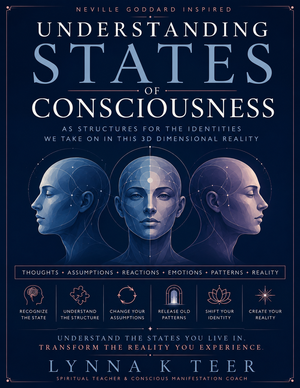
Every experience emerges from a state of consciousness.
A state includes assumptions, expectations, emotional reactions, self-concept, and identity. Someone occupying a state of confidence experiences life differently than someone occupying a state of insecurity. Someone occupying a state of abundance experiences life differently than someone occupying a state of lack.
The state is the determining factor.
Why Positive Thinking Is Not Enough
Affirmations are often associated with positive thinking. While positive thinking can improve mood, it is not the same thing as changing states.
A person can think positive thoughts while remaining identified with insecurity. The objective is not merely to think differently. The objective is to become different.
Self-Concept and Affirmations
Self-concept refers to the assumptions you hold about yourself. Do you believe you are valuable, respected, appreciated, chosen, and capable? These assumptions influence every area of life.
An affirmation that supports a healthier self-concept can be useful. The purpose is helping a new identity become familiar.
Neville Goddard's Use of Affirmations
When Neville used the word affirm, he was often referring to accepting something as true within consciousness rather than repeating words endlessly.
A person can repeat "I am successful" for hours each day while remaining identified with failure. Another person may quietly accept a new conception of themselves without formal repetition. The second individual is often closer to Neville's teaching.
Inner Conversations: The Affirmations You Are Already Repeating
Many people focus on affirmations they consciously choose while overlooking the affirmations they repeat unconsciously throughout the day.
Neville frequently discussed inner conversations. Statements such as "Nothing ever works out for me" or "I never have enough money" are affirmations as well. They simply reinforce unwanted states.
Scripture and the Power of Identity
Neville viewed scripture as psychological revelation.
"As a man thinketh in his heart, so is he."
The emphasis is on identity. Every affirmation follows the phrase "I AM." The deeper question is whether what follows reflects a state that has become natural.
A Practical Exercise
For one week, observe your inner conversations, expectations, reactions, and self-concept. Write down recurring patterns. Do not judge them. Simply become aware.
Awareness reveals the state. Once the state becomes visible, transformation becomes possible.
Why Manifestation Seems Inconsistent
Many people notice that manifestation appears inconsistent. Often the affirmation points in one direction while the state points in another. The desire points one way. The state points another. Experience follows the state.
FAQ
Do affirmations work?
Yes, when they help stabilize a new state of consciousness.
How many times should I repeat an affirmation?
There is no magical number. The goal is familiarity with a new identity.
Why do affirmations sometimes make me feel worse?
They may reveal a conflict between your current state and the state you are attempting to assume.
What is more important than affirmations?
Understanding states of consciousness.
Final Thoughts
Affirmations are neither useless nor magical. Their effectiveness depends largely upon how they are used.
When treated as mechanical formulas, they often produce frustration. When used as tools to help stabilize a different state of consciousness, they can become valuable aids in personal transformation.
The deeper question is not, "What affirmation should I repeat?" The deeper question is, "Who am I conscious of being?"