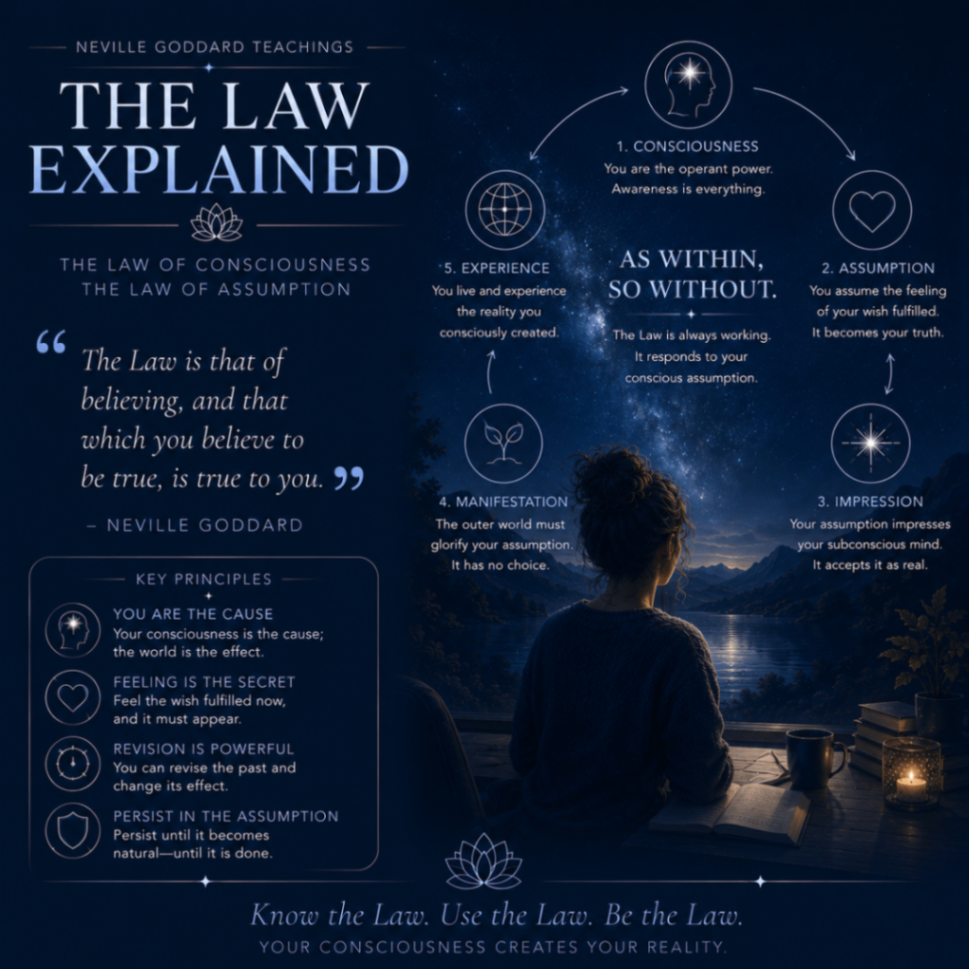
Neville Goddard explained that the law is the basis of understanding conscious creation, or in simple terms, manifestation.
He did not present it as a technique, a motivational philosophy, or a spiritual shortcut for getting what you want. Instead, Neville described The Law as a principle of causation operating within consciousness. This law was shown to us in the Old Testament.
Understanding The Law requires stepping away from modern manifestation trends and returning to the foundation of his teachings.
Manifestation, as Neville explained it, is not about:
- Effort
- Forcing emotion
- Managing vibration
- Repeating affirmations endlessly
- Trying to make life respond
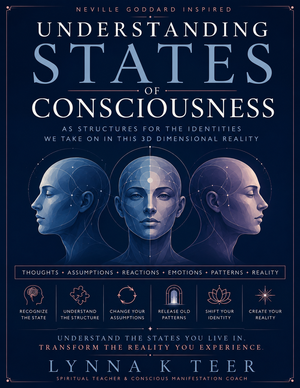
Instead, manifestation is about states of consciousness, identity, and the quiet assumptions that feel natural within the mind. Your life reorganizes according to what you assume yourself to be.
This is the central principle behind Neville Goddard's Law of Assumption. When this principle is understood clearly, manifestation becomes far simpler and far less exhausting.
Neville Goddard and the Biblical Foundation of The Law
Neville Goddard repeatedly emphasized that The Law did not originate with him.
According to Neville, The Law is the psychological truth embedded within the Old Testament, expressed through symbolism, allegory, and the inner meaning of Scripture.
When approached through Neville's interpretation, the Bible is not primarily a historical account or religious doctrine. Instead, it becomes a psychological map describing how consciousness creates experience.
In this framework:
- Biblical characters represent states of consciousness
- Locations represent psychological conditions
- Conflicts represent inner struggles of identity
- Transformations represent shifts in awareness
The Difference Between Attraction and Causation
Many modern manifestation teachings are built on the idea of attraction. You are told to attract money, love, opportunities, success, and abundance.
This language subtly implies that what you desire exists outside of you, somewhere in the world, waiting to be pulled toward you through visualization, emotional intensity, or vibration. This model positions the individual as separate from fulfillment.
Neville Goddard rejected this entire framework.
Neville did not teach attraction.
He taught causation.
Your world does not rearrange itself because of desire. It reorganizes itself according to the state of consciousness you occupy.
Identity as the Creative Cause
At the center of Neville Goddard's teaching is a simple but profound idea:
Your concept of self determines your experience of life.
Neville referred to this concept of self as I AM. What you believe yourself to be shapes:
- How you perceive events
- How you interpret opportunities
- How you respond to circumstances
- How others interact with you
Over time, these internal assumptions externalize as lived experience. The Law does not respond to effort. It responds to identity.
Why Circumstances Cannot Be the Cause
Most people grow up believing that circumstances determine identity. For example:
- "I will feel confident once I succeed."
- "I will feel secure once I have enough money."
- "I will feel loved once someone chooses me."
Neville reversed this structure entirely. He taught that circumstances are reflections of state, not the source of identity.
When people attempt to change life through external effort alone, they are working at the level of effect rather than cause. Even when external improvements occur, the underlying state remains unchanged. Over time, the same patterns tend to return.
What Neville Goddard Meant by States of Consciousness
A state is not simply an emotion. You can feel excited and still live in limitation. You can feel calm and still assume lack.
A state is an identity position. It is the quiet internal sense of what feels normal to you. States determine:
- What you expect from life
- What you consider possible
- What feels safe or threatening
- How you interpret events
States often operate beneath conscious awareness. Because they feel familiar, they appear invisible. They feel like reality itself.
Why Effort Often Blocks Manifestation
Effort often reveals the presence of a state of lack.
Trying implies not having.
Striving implies separation.
Chasing implies absence.
When manifestation feels exhausting, it is often because effort itself is communicating the assumption. The Law responds impersonally to identity, not to techniques.
Identity Is the Creative Power
Neville summarized The Law in a statement that clarifies manifestation completely:
You do not attract what you want. You externalize what you assume to be true.
States change through recognition, not force. You do not become something new through effort. Instead, you release identification with assumptions that no longer serve you.
When identity shifts, life reorganizes around that change. Circumstances adjust. Behavior evolves. Opportunities appear. Manifestation becomes quieter and more natural.
A Question to Reflect On
Instead of asking "How do I get this?" Neville suggested asking a different question:
Who would I be if this were already natural?
This question moves attention away from desire and toward identity. When identity shifts, experience follows. Life is no longer something to chase. It becomes something to express.
Continue Studying Neville Goddard's Teachings
If you want to deepen your understanding of The Law, the best place to begin is with his original lectures. You can listen to them through The Neville Goddard Lectures Podcast, where the teachings are presented in their original form.
You can also explore lecture archives and study materials at NevilleGoddardOfficial.com.
The Law is already operating.
The only question is which state of consciousness you are living from.